


We’re at a critical point for the country’s infrastructure and change is on the horizon as a result of the challenges we’re facing, says Philip Dawes, New Zealand Research Manager for Pacifecon, which has recently released a report called Local Government Reform.
“It’s important we get these changes right, focus on core services and align local priorities with the national objective of economic growth.
“Councils are working through a significant amount of uncertainty as details on the reforms are still being developed and refined,” says Philip.
Some of the new legislation being introduced includes two resource management acts: the Planning Act – a framework for planning and regulating the use, development and enjoyment of land, and the Natural Environment Act – a framework for use, protection and enhancement of the natural environment. There’s also talk of a possible Enforcement Act.
“The impact of these acts is the introduction of a regional spatial plan, which is jointly presented by councils and a combined regional e-plan [an interactive, online plan], which incorporates a land use plan prepared by individual councils and a natural environment plan prepared by unitary authorities.”
There’s also the possibility of a national compliance and enforcement regulator for more consistent enforcement across the country. Other new legislation includes the Resource Management (Duration of Consents) Amendment Act 2025, which provides transitional provisions until a new regime is in place, as well as various bills to speed up the consenting process, and new earthquake legislation to regulate only high-risk building types in medium and high seismic zones.
“For the construction industry, there is optimism around efforts to reduce consenting delays and streamline planning processes, although many of the practical details are still being worked through.”
Some changes to reform include:
Water: Over 40 distinct water entities and more than 40 new water strategies. More regional partnerships are expected.
Resource management: Councils must halt most plan and policy statement changes until the end of next year, with some exceptions. Compliance and enforcement will be stepped up.
Land Transport: Work has been halted on previously funded projects, such as walking and cycling paths. The focus is on roads of national significance.
Climate Change: The ban on new oil and gas exploration has been lifted. The Government is working on various energy initiatives to boost renewable energy and realise this country’s clean energy potential.
There’s more waiting in the wings, too, with pending legislation, including rates capping to be fully implemented by 1 July 2029, which will result in tighter budgets and less money for councils.
There are also plans to simplify local government by removing regional councillors, a ‘Head Start’ pathway for councils wishing to ‘go early’ on amalgamation and establish a unitary authority.
For building and construction, the introduction of voluntary consolidation of Building Consent Authorities (BCAs) is pending. This would mean councils are no longer required to be a BCA, updating and standardising of regulations to eliminate duplication, plus incentivising collaboration.
The report also breaks down Pacifecon’s pipeline project numbers for public and private sectors.
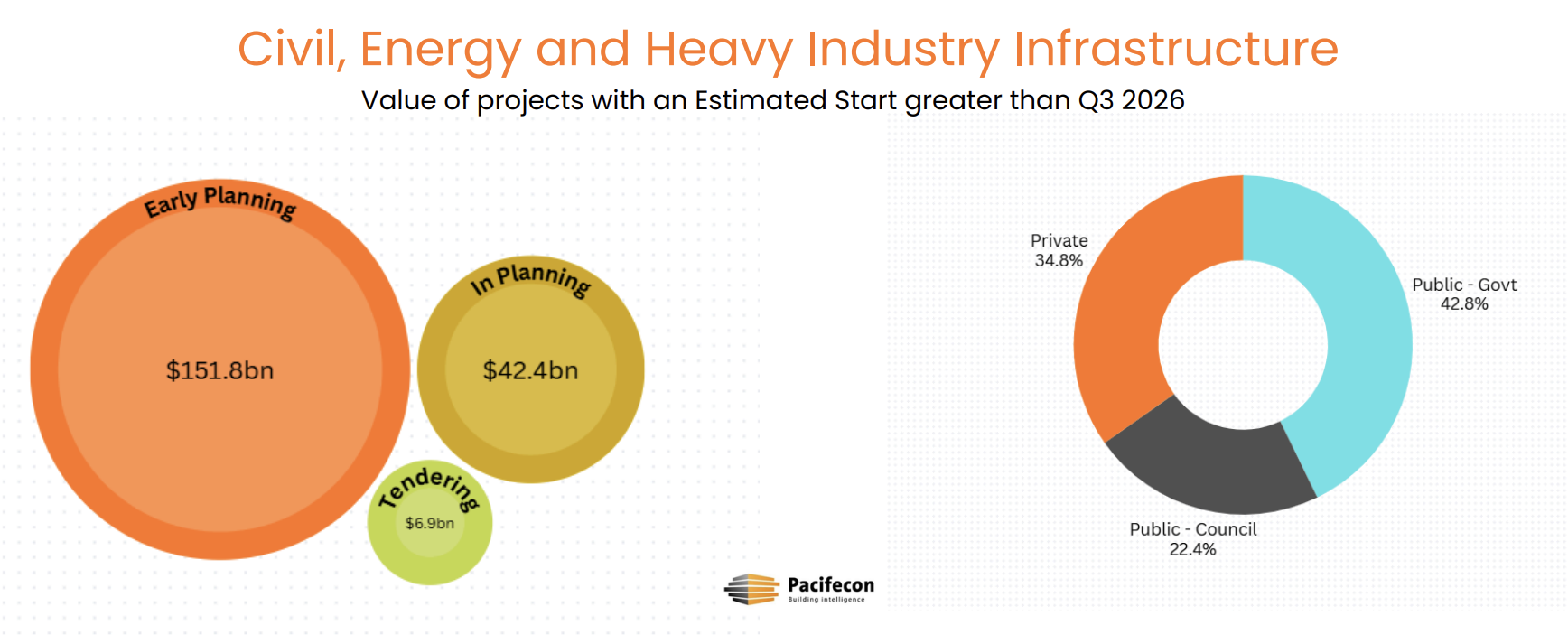
Civil, Energy and Heavy Industry Infrastructure: $151.8 billion in early planning, $42.4 billion in planning and $6.9 billion in tendering.
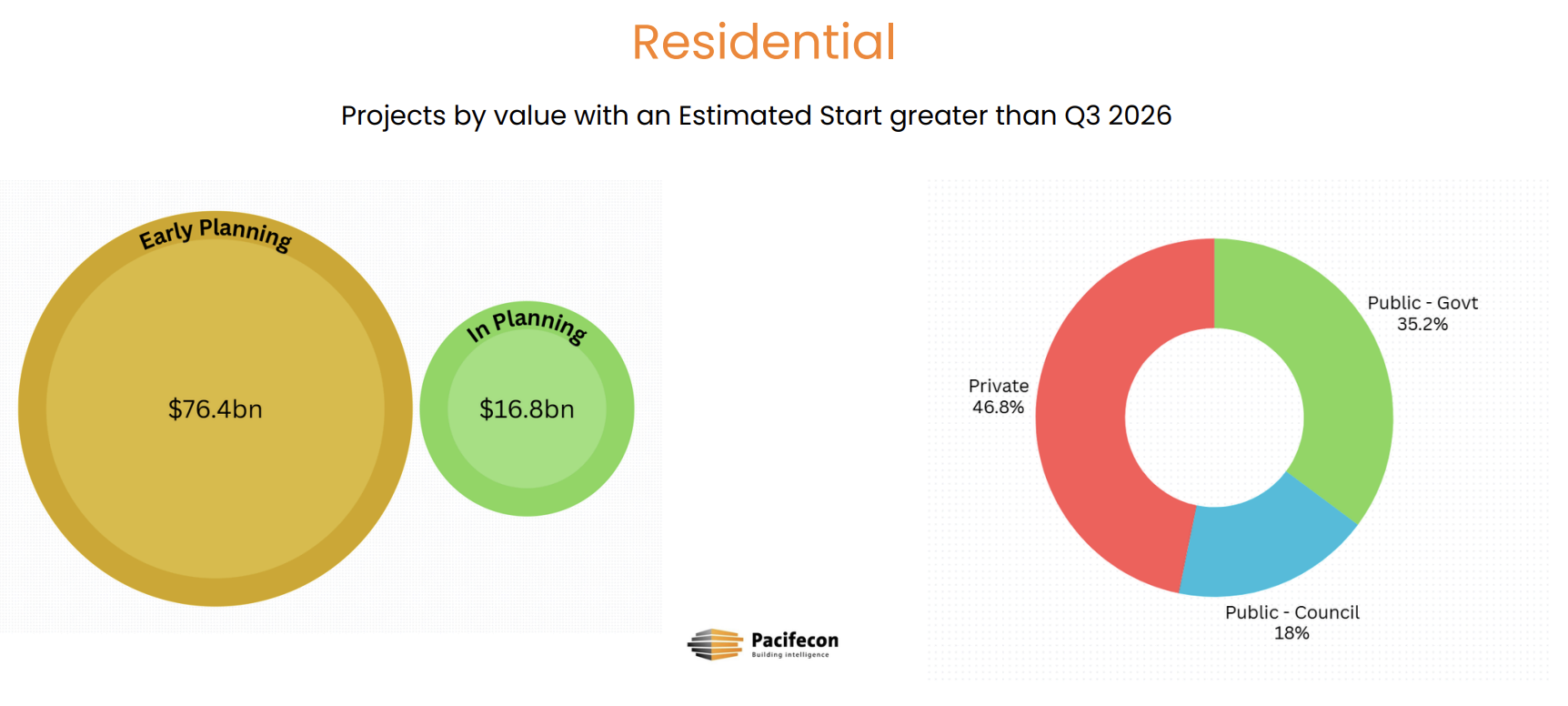
Residential: $76.4 billion in early planning and $16.8 billion in planning.
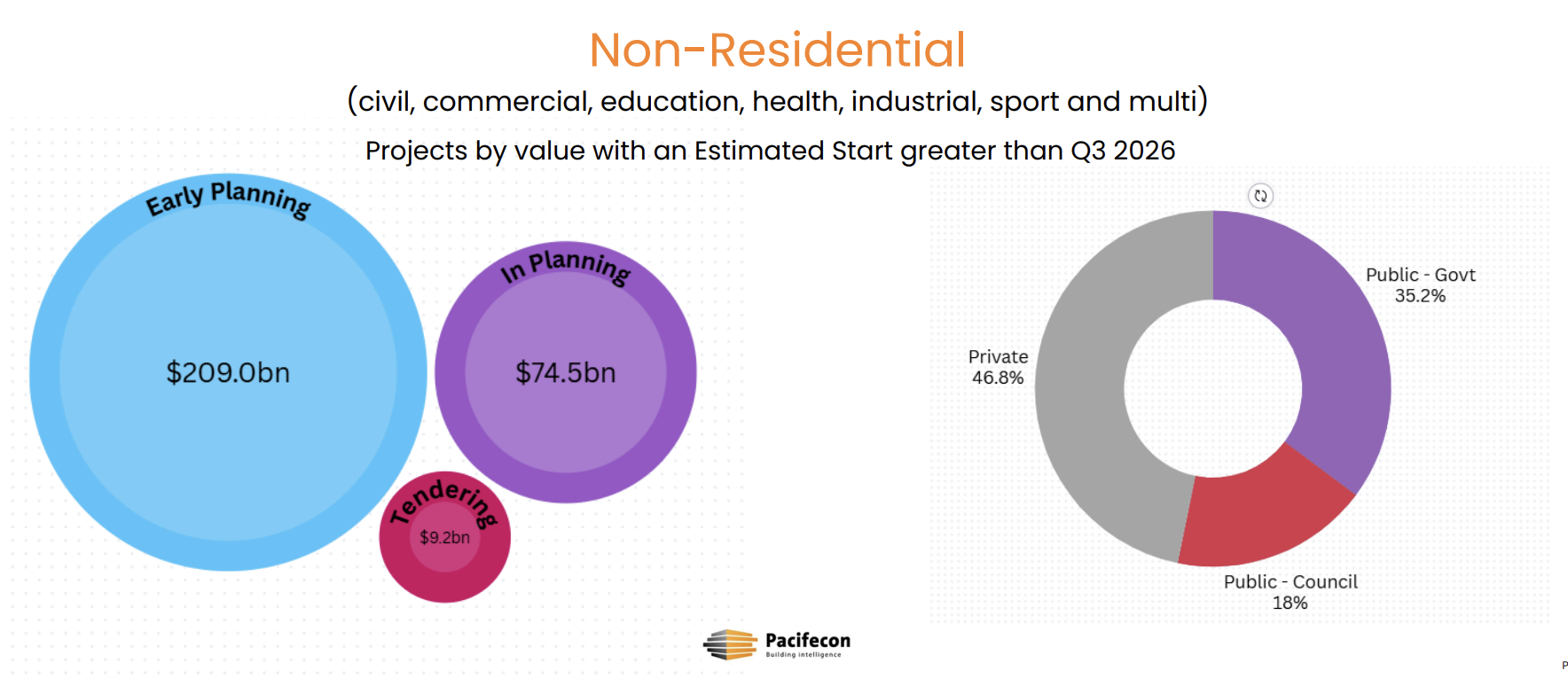 Non-residential – civil, commercial, education, health, industrial, sport and multi: $209.0 billion in early planning, $74.5 billion in planning and $9.2 billion in tendering.
“While details are still coming, the reduction in red tape for construction will be welcome,” says Philip.
Email projects@pacifecon.co.nz to request a copy of the free Local Government Reform report.