
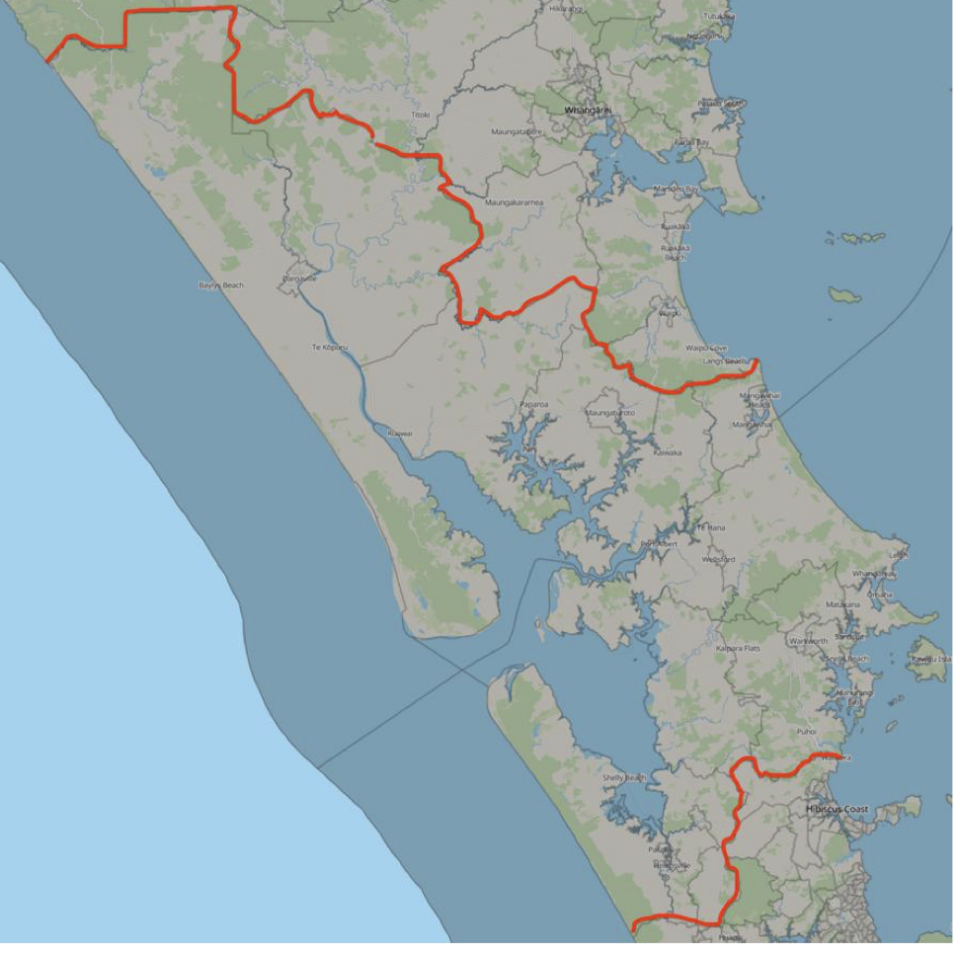

Image: Diagram of possible Unitary Authority boundary.
Bill Foster, Chair of the Northern Action Group, explains the reasoning behind merging the Kaipara District with North Rodney into a Unitary Authority to address the Government’s regional governance simplification objective.
The councils of the Kaipara and North Rodney Districts are exploring options for merging the two (currently within Auckland Council) into a single, predominantly rural–coastal Unitary Authority.
The reasoning includes structural constraints Kaipara faces with its large land area, small and unevenly wealthy ratepayer base, significant infrastructure renewal pressures, and a real risk of being subsumed within a Northland regional configuration dominated by different interests of Whangarei and the Far North.
Northern Rodney faces a parallel but inverse problem: scale without local control, operating within a metropolitan system that treats the area primarily as a rate source, growth sink, holiday hinterland, and infrastructure externality.
The merger option responds to both sets of constraints by realigning governance to geography, community structure, and service realities.
The Kaipara District has 30,000 residents and Northern Rodney 50,000. A combined district of between 80,000 and 100,000 residents (with strong growth expected) would move Kaipara from sub-scale fragility to necessary scale, while giving North Rodney local control without metropolitan overhead it gets no benefit from.
There are also shared natural alignment and commonalities between the two districts. Shared catchments of the Kaipara Harbour and Mahurangi catchment form a coherent environmental and planning unit, distinct from Auckland and Northland urban systems.
Their settlement pattern is predominantly rural, coastal, river-mouth and service-town communities, not a city – and poorly served by city-centric governance models.
The ‘infrastructure reality’ is a high reliance on district roading for economic and social connectivity, fragmented water and wastewater systems with stormwater and overland flow management a shared challenge.
Shared ‘growth dynamics’ include (east coast) coastal settlements and (west coast) Kaipara Harbour communities; rural production across the district; and motorway-driven growth pressure affecting Wellsford and Mangawhai that renders the current boundary increasingly arbitrary.
Overall, the combining of these districts would improve fiscal resilience through a broader ratepayer base without metropolitan cost structures; provide economies of scale for district-level services (water, roading, parks, reserves, planning, administration); and stronger planning capability: moving beyond zoning-only plans toward active economic, employment, service and infrastructure visioning.
It will also enhance ‘local democracy’ with community-based decision-making that recognises east–west differences rather than suppressing them. It also creates stronger external advocacy: a district large enough to be heard but distinct enough to avoid capture by Auckland or Northland city interests. And there’s the strength of shared environmental guardianship of the Kaipara and Mahurangi as an integrated system.
Known risks and objections include Kaipara’s historical governance issues and infrastructure deficits; a perceived wealth transfer from North Rodney to Kaipara; transition and setup costs, administrative complexity, and institutional inertia; and the risk that a new authority could default back to conventional, centralised local government behaviour.
While these risks are real they are governance design problems, not arguments against examining the option.
This is an idea time for this to be discussed and explored. The current central government reforms offer limited pathways for rational, place-based local government restructuring. This option allows Kaipara to shape its future proactively, rather than reacting to regional consolidation pressures later. If communities do not articulate credible alternatives, outcomes will be imposed by default.
This is an opportunity for Kaipara Council (not endorsement) to agree to actively engage in shaping the reform agenda by asking the Government to jointly explore the Kaipara–North Rodney Unitary Authority option, including high-level financial feasibility, governance design principles, and community appetite.