
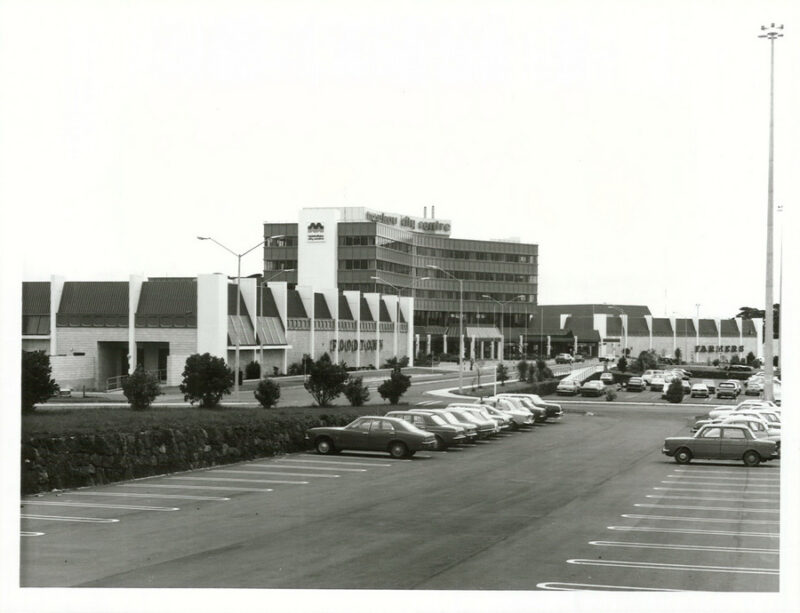

Image: Manukau City Centre shopping complex in 1977. Photo by G. Reithmaier.
It was the most progressive city in New Zealand. The city was young, and yet it was the second-biggest city in the country (or third, depending on who you believed and whether you went by size or population), writes Linda O’Reilly from Tompkins Wake.
The Manukau Civic Centre building was a shining white tower designed by renowned architect Neville Price. At its peak, there were around 2500 employees and it represented more than 160 ethnic groups over a population of 330,000 people.
‘The Manukau Way’ was a people-centred, culturally grounded, action-oriented approach to civic leadership, rooted in diversity, community trust, and confidence in Manukau’s identity as a city.
Although Manukau City was amalgamated into the Auckland Council in October 2010, the Manukau Way lingers on in South Auckland’s people – first governance, proud diversity, strong Pacific and Maori leadership, enduring civic infrastructure, and a confident local identity that continues to shape how Auckland Council works today.
The Mayor of Manukau City was Sir Barry Curtis and last month I attended his funeral in the arena of the Due Drop Events Centre, the magnificent stadium visible from the southern motorway that was one of Sir Barry Curtis’ long-held civic ambitions for Manukau.
Of course, Sir Barry was not the only Mayor of Manukau, but he was the longest serving and the voice and face most people would associate with Manukau City.
His term also coincided with my periods as an employee of the Council and later as a legal advisor in private practice. It was a rewarding and exciting time and place to work in local government.
The city was growing at a rapid pace, with commercial and industrial development filling in the space at Wiri between the Great South Road and the Manukau Harbour, and housing carpeting the formerly green spaces from Manurewa to Weymouth and from Howick through Botany, right through to the Redoubt Road ridge.
For years, as an assistant property manager, I carried a detailed map of the entire city in my head. That map is gone now and the subsequent growth has far outstripped my knowledge.
The growth of the city was never random; it was planned from the outset. And it was not just about houses, shops, and places to work. It was about parks, sporting facilities, civic spaces, and, not least, treating arts and recreation facilities as a public good, not a private luxury. Growth was linked to infrastructure and social outcomes.
To this end, new suburbs and centres were designed around parks, libraries, and leisure centres, and arts and recreation were funded as part of long-term capital programmes rather than short-term grants. Creativity was valued at all levels, and, in a sense, the city sang – at least you could feel the hum of activity beneath your feet.
Sir Barry Curtis, the son of an Irish immigrant, was the face of this city and drove its forward momentum with all the force he could muster. That force was considerable, as some of those speaking at his funeral attested.
It must be said that the many attendees were a sea of grey hair and grey beards. Sir Barry’s generation and those who worked alongside him are aging. Youth were represented by the Otahuhu College kapa haka group (his old school and mine), and my seven-year-old grandson, en route home after a week with me ‘up north’.
But that ‘elderly’ group was an impressive testament to the sway Sir Barry held in local government. There were mayors and councillors, former and present, of Manukau and other local authorities. There were representatives of the Maori, Pasifika, Asian, and other communities.
There were central government politicians, current and past, and a quite astounding number of politicians who had been both members of Parliament and councillors. There were chief executives, directors, and senior staff of Manukau and other local authorities, those who worked most closely with him and others who played supporting roles, like me – not to mention community and business leaders who had worked with and assisted Sir Barry in his many visionary projects for Manukau.
We were there to honour the man we remembered but I suspect that more than a few of us were also there to honour what Manukau City represented.
In the current climate that seems like a more representative, more inclusive, and more ambitious version of local government and what it can achieve.
Drive around the former Manukau and take a look. (Note that you will probably have to drive, because the distances are vast and public transport remains less than ideal.) What you will see are busy urban centres, wide street corridors that beg for bus lanes and light rail, parks and open spaces both big and small with high-quality recreational facilities, artwork in public spaces, future-proofed infrastructure, well-serviced industrial areas, and much more. It is not perfect but the standards set were high and are standing the test of time.
I cannot help feeling that Manukau represented a kinder, gentler era of local government. It had councillors from the Howick ward who, until their orientation bus tour, had never set foot in Mangere unless they were going to the airport, and vice versa, of course.
But, by the end of a three-year term, with Sir Barry leading by example, they were all pulling together for the city, without rancour, without aggressive displays of anger or temperament, and with mutual respect.
Things got done, always with a view to the future, and it did not take forever to make them happen.
So, I mourned Sir Barry and his legacy, and I mourned the city I once lived and worked in and loved.