

As regular as a royal visit, every few years the issue of local government reorganisation rears its head – and then quickly fades away. Reform is now back on the agenda with “increased potential for chaos and confusion” writes Dr Andy Asquith from the School of Social Sciences at Monash University in Melbourne.
In the past, efforts have been distinctly regional – think of attempts to amalgamate in Hawke’s Bay or Northland. This time it’s nationwide.
It is to be council-led. Given that the current and former local government ministers have had little appreciation or understanding of the sector, they are effectively washing their hands of the process.
Ergo, when it all turns to custard, they can hold their hands up and say they are not to blame – it is the incompetents in local councils.
Given that we are so close to an election, the outcome of which I’d suggest is too close to call, do we want the resources being poured into something that may well not come to fruition?
The gold standard mantra for local government reform is “form, function and finance”. That is, you tackle the intertwined issues of structure, function and finance in one go. You do not tinker at the edges.
The proposals do not, by any means, guarantee an end to the complexity or cost associated with the current structure. Rather, I’d suggest we are offered increased potential for chaos and confusion. The ministers’ press release talked about simplifying the current system. What we risk is an even more complex set of ‘solutions’. Each group of councils that comes together will create their own bespoke model, with groups trying to outdo their peers.
I’d suggest that with three major sector reforms on the table – RMA, abolition of regional councils and rate capping – then councils are already stretched.
Now the Government has added an extra burden that I seriously doubt the sector can absorb. Let’s not be in any doubt – austerity is alive and well across the sector. While some right-wing commentators may still like to write about local government ‘fat cats’, these are definitely a thing of the past.
Tellingly, given that the intention is to strengthen local government, the words “democracy”, “engagement”, and “participation” are strangely missing from last month’s ministerial announcement. While the announcement does refer to “accountability” and “making it easier for councils to deliver for their communities”, there is scant evidence as to how this will occur. Evidence – such a filthy word – is sadly lacking from the proposals outlined by Bishop and Watts. Just to be clear, we are talking about local government.
The clear line here is one of amalgamation to create bigger entities – perhaps a ‘halfway house’ between the current structure and hyper-regionalism. What will happen is that the distance between Kiwis and their local council will get bigger – the local government gets increasingly distant.
There is ample evidence which shows that we are far more engaged in local government if our council is seen as being local.
There are a small number of councils in the South Island that have enjoyed voter participation rates of more than 60 percent.
Compare this to the dismal figures for Auckland and other bigger cities. We are at risk of engineering a complete disconnect between citizens and the local government institutions. The logical end point here is that with so few engaging with local government, Wellington will simply abolish it – on grounds of efficiency!
As an aside here, there is a view that our country is ‘over-governed’, that there are too many local councils. The figure below – produced using data from the Organisation of Economic Cooperation and Development and United Cities and Local Governments – show that by international standards, this is far from the case.
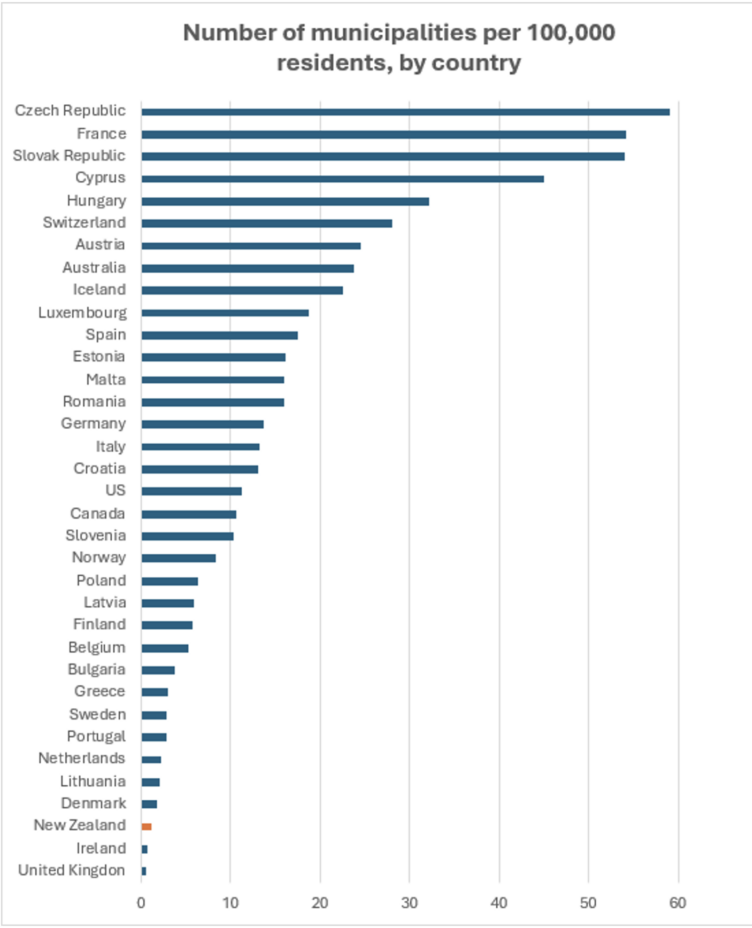
Once more, we witness ideology trumping evidence. Major reform needs a thoughtful approach, not a three-month rushed approach.
The Future for Local Government Report (June 2023) took a considered view. Ministers need to remember that, despite attempts to pin blame on local councils for the unpopularity of any proposed amalgamations, there is a long history of central government politicians seeking to tamper with local government structures – all of which end with the ministers getting their fingers burnt.
I clearly remember Keiran McAnulty (Labour MP) on RNZ’s Morning Report the day after the Future for Local Government was published. Included in the report was mention of either voluntary amalgamations or forced ones. The Minister couldn’t put enough distance between himself and this recommendation.
Whatever the outcome of this process, local government will continue to serve our communities.
As a former mayor in the Wairarapa once put it to me, the current hodgepodge of a system ‘works’ not because of the institutional or organisational arrangements, but because of the skill, dedication and commitment of the thousands who either work in or serve as elected representatives in our councils. Whatever ‘solution’ is produced by the bureaucratic sausage machine, this skill, dedication and commitment will not stop.