
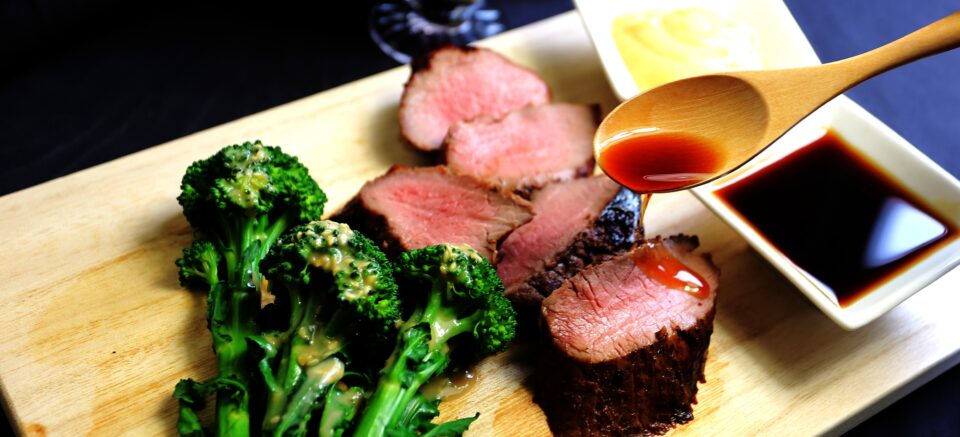

Image: NZ lamb fillet. Photo: Alan Titchall.
Our Government has joined other countries like South Korea, Singapore and Thailand where tourism authorities have paid millions to be part of the European, French-owned Michelin Guide’s star rating of eateries. By Alan Titchall, ex- restaurateur and food writer.
Through state-owned Tourism New Zealand this is a three-year deal paid for from TNZ’s budget and partly from the International Visitor Levy which supposedly funds infrastructure and conservation. Michelin’s anonymous inspectors will only visit eateries in Auckland, Wellington, Christchurch, and Queenstown.
Founded 120 years ago, the series of Michelin guide books are still published by the French tyre company.
The Taxpayers’ Union has called it “a lavish subsidy for top-tier restaurants.
“At a time when the Government are trying to find savings and Kiwis are battling through a cost-of-living crisis, chucking $6.3 million away so fine diners can get a Michelin-star dinner is a bad look. Gambling on tens of thousands of visitors deciding to hop on a long-haul flight for their next meal is not responsible spending.”
The original travel guide was founded in 1900 by Andre and Edouard Michelin who owned a tyre company in France. Independently reviewed restaurants were added to the guide in 1920 and the current 3-star ranking system was first published in 1936. The Guide went to America (where some smaller city authorities also pay to be included) in 2005, followed by Japan (which paid for the launch) in 2007. Michelin is said to have sold 100,000 copies of the guide in Japan on the first day it launched. News sources in Australia claim the Michelin Guide approached Tourism Australia back in June last year with a proposal to establish an Australian edition at a cost of A$17.33 million over five years from Tourism Australia and was knocked back.
Tourism Minister Louise Upston and TNZ Chief Executive Rene de Monchy justified the ‘investment’ as a showcase of the “very best of New Zealand’s food, wine and hospitality” and ‘could’ attract an estimated 35,000–36,000 new high-spending visitors each year. Reportedly, De Monchy referred to TNZ research suggesting that over 80 per cent of wealthy potential tourists would be more likely to visit if we had the Michelin Guide.
The problem with this is that our high-spending tourists are more likely to be helicoptered between private lodges in remote locations and to Queenstown and its surrounding cuisine region, which are not included.
Then there is the fact that most Michelin restaurants around the world (80%) feature just the one star, and include any type of eatery, even street food. The current 145 exclusive three- star restaurants are mostly found in France (31), Japan (20), US (13), and Spain (16). Three stars will be very difficult to achieve in a country with such a small top-end restaurant market, such as our own.
And why are we relying on our cuisine being judged by ‘European’ standards when we have judging criteria (e.g. Cuisine magazine’s three-hat rating) of our own. Hopefully, the judges will be local, as New Zealand doesn’t have a ‘cuisine’ – we have a fast-paced history of food fashion going back to the 19th century when American cuisine/cooking was prolific here. Our dining cuisine is still predominately US-influenced using Kiwi produce – including the Asian–European fusion from the US West Coast.
On the positive side, the Michelin judging system is proven in the US and in numerous Asian countries with different cuisines and food tastes – and it places things like ‘consistency’ of delivery (through multiple visits) first. Which is another problem for many of our eateries – their ownership and even life expectancy is notoriously short here.