
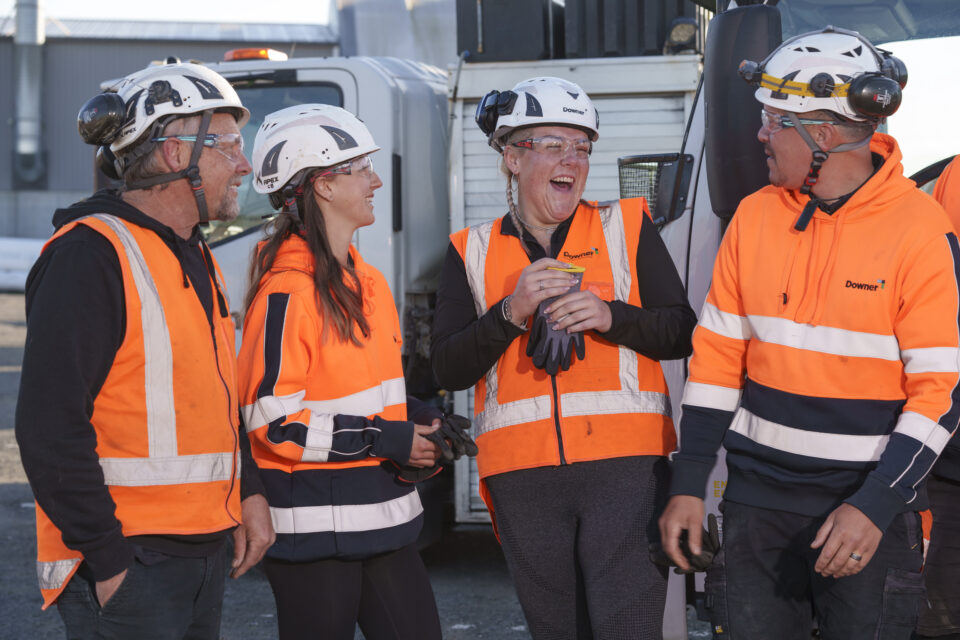

Image: From left: Greg Black, Charlotte Bishop, Amelia Holdaway, and Jordan Kotua-Tekoronga.
The shortage of skills in our water services requires a holistic approach with greater collaboration between private contractors, service providers, local government, industry bodies, and educational institutions, writes Alexa Langdale, the Marketing and Communications Manager at Downer.
It’s no secret that we are experiencing a significant brain drain with high volumes of tertiary educated and skilled workers setting their sights overseas.
This talent drain, along with the Government’s Local Water Done Well reforms shaping the strategic direction of our water services, means an inevitable increase in the demand for frontline career opportunities in our water sector.
There’s no quick fix. However, what is needed is a holistic approach that comes from greater collaboration between private contractors, service providers, local government and industry bodies, and educational institutions.
Inspiring future generations
Attracting younger people into a traditional industry requires a multifaceted approach – we need to focus on making the subject matter fun and educate our children and communities about where water comes from, what happens when we flush a toilet, and who looks after our environment during a big weather event.
These conversations need to start from kindergarten age. Exposure to these topics will help plant the seed and grow into genuine curiosity in the hearts and minds of children, which will eventually spark interest about careers in the water industry.
We need to continue to present about water careers to high school students, both online and in person, creating engaging career advisory programmes that help promote meaningful and diverse water-career pathways, listing ‘Water Serviceperson’ and other water roles under common trades – much like we do with plumbers and electricians.
We have local boards, industry associations such as Water New Zealand, and contractors who are doing a great job of all these things already. But what would happen if we looked at raising the level of ‘water talent’ as an industry, rather than as individual entities? Are we giving people adequate opportunities and incentives to stay and work here and help us deliver the Government’s water services programme and, in turn, protect and secure our future water services?
A multi-faceted approach to recruitment
Louise Boyd, the Downer General Manager – Water Services & Projects says: “The future of our water industry depends on inspiring young professionals to lead with knowledge, dedication, and innovation – tackling ageing assets and tired infrastructure, while working hand in hand with our communities to protect and restore our precious water for generations to come.”
Downer has several programmes in place which are working well, but there is still much work to be done, with a willingness to ‘innovate’ in the recruitment space. The company’s in-house Social Impact and Reputation team run multiple employment pathway programmes (some in collaboration with the Ministry of Social Development and Te Puni Kokori), as well as partnerships with training providers to attract new talent to the industry.
For example, in the Water team alone since 2020, 68 people have completed employment pathway programmes such as Water Ready, employment and transition support into the industry for job seekers. Others include programmes specifically tailored to Tangata Pasifika, Rangatahi Maori and Wahine Toa – focusing on the cultural principles of Pacific and te ao Maori as a basis for learning and development.
Pay over purpose
Purpose matters. As Nelson-based Water team members, Kemble Slotemaker and Charlotte Bishop discovered, sometimes a temporary role can ignite a lifelong career. Kemble and Charlotte had been looking for work over summer and both found temping in Downer’s Water team through word of mouth. They quickly become permanent members of the team, completing two-year apprenticeships which allowed them to get hands-on experience while studying towards their NZQA qualifications in Water Treatment – without the weight of a student loan.
The apprenticeships also opened them up to a world of opportunities to enter other disciplines like Wastewater and Stormwater, as well as other sectors across Downer.
What’s clear is that it’s not just pay that drives the younger generation of New Zealanders when chasing a career. It’s about purpose and making a tangible difference.
The water sector offers that in abundance, protecting water while building resilience in communities. By highlighting this connection between purpose, sustainability, and opportunity, we can transform perceptions of the water industry from traditional and technical to innovative, inclusive, and indispensable.
Technology hand in hand with sustainability
Water is life and protecting it is one of the most meaningful contributions to the planet’s future. Working in the water industry is sustainability action at its most practical and building systems that protect our ecosystems and communities for future generations.
Technically, the future of water is digital. From smart sensors that track water quality in real time, to AI-powered systems predicting and preventing leaks before they happen. The water industry has become a hub for innovation.
This creates exciting new roles in environmental technology, data science, and digital engineering to attract those who want to work with ‘purpose’ while driving ‘sustainable’ progress.
Passing the baton: developing industry leaders
Downer is equally committed to developing the leaders and mentors who will nurture the next generation through its Inspiring Leaders Programme.
This emphasis on knowledge transfer ensures that institutional wisdom becomes an asset shared across generations, not lost to attrition or migration.
Are we bridging the education gap between finding purpose and just having a job?
To compete with overseas competitors, our water industry needs to collaborate and act today to build a sustainable future.
Our call to action is that we work together, to enable a secure and sustainable future for New Zealand’s water industry. Together, we need to attract the curious, creative, and those care about our water industry.
Together, we can reimagine how we all manage our most precious resource and build a future where innovation, inclusion, and sustainability flow together.